
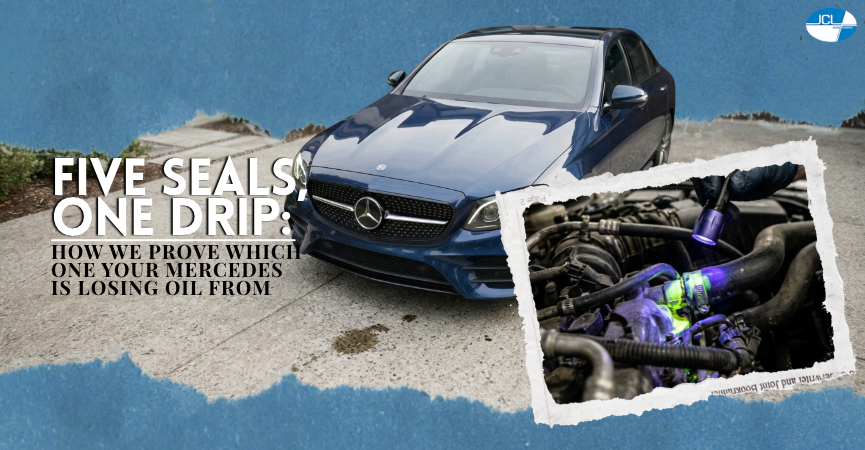
Ask five people where a Mercedes leaks and you will get five confident answers, all of them plausible and most of them wrong for your car. Oil travels. It leaves a joint at the top of the engine, runs along a casting rib, crosses to the transmission bellhousing, and falls onto the driveway two feet from where it started.
So this job is not an opinion offered across the counter. It is a short sequence of tests that ends with somebody pointing at a specific seal and being able to show you why.
Quick Summary: Key Takeaways
- Where it lands is rarely where it leaks: oil runs downhill and sideways before it falls.
- Fluorescent dye marks the source: it circulates with the oil and glows under UV at the exact point of escape.
- Pressure changes the answer: some seals only weep with the engine running and the oil hot.
Step one is making the engine readable
An engine that has been leaking for two years is uniformly black underneath, and no amount of squinting will tell you which part of that film is from last Tuesday. The underside gets degreased and dried before anything else happens, and on a badly soaked car that alone takes real time.
Then the car goes back on the road. A few days of normal driving around Hellertown and down to Bethlehem gives fresh oil somewhere to show, and clean aluminum makes it obvious.
Step two is dye, and it is the part that settles arguments
A small bottle of fluorescent tracer goes into the oil fill, circulates with everything else, and leaves with whatever escapes. Under a UV lamp in a dark bay, the escaping oil glows bright green while the old road grime stays dull.
That distinction is the whole value. It separates what is leaking now from the twenty years of film that got there before you owned the car, and it will frequently show two sources where everyone assumed there was one. A Mercedes with a weeping oil filter housing and a tired valve cover gasket looks exactly like a Mercedes with just one of them, right up until the light goes on.
The dye is safe to leave in the oil, which matters, because the useful reading often comes a week later rather than the same afternoon.
→ see what we work on and the services we offer
Step three is testing under the conditions the leak actually happens in
Some joints only give up when the oil is hot and thin, or when crankcase pressure is high, or when the engine is twisted slightly under load. Checking a cold engine on a lift misses all of that.
So the car gets run to temperature before it is inspected, and where the symptoms suggest it we will look at crankcase pressure as well, because a blocked breather turns healthy seals into leaking ones and replacing them solves nothing. A borescope through a plug hole or down a tight gap is sometimes the only way to see a rear seal area without pulling the transmission.
An hour of testing against a wrong gasket
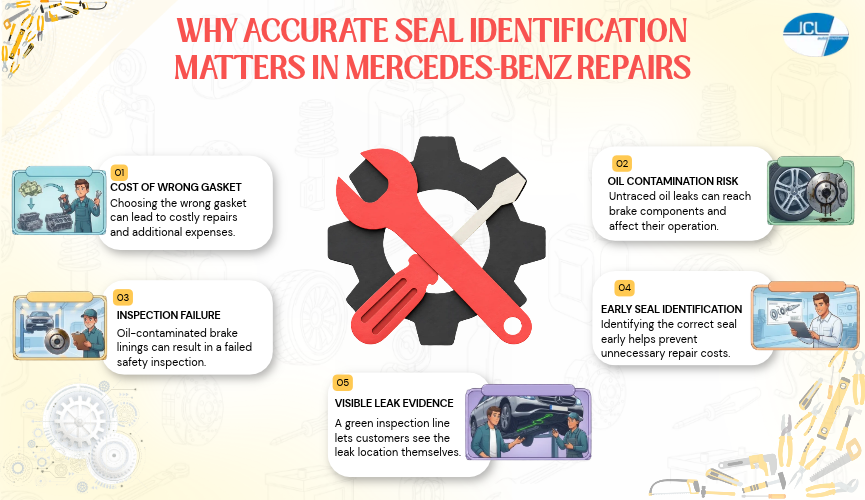
Guessing is expensive, and a wrong gasket is not a small mistake any more. There is also a cost most owners never think about until inspection day. Oil that is allowed to travel does not stop at the engine, and Pennsylvania’s safety inspection rules have the inspector reject a car when brake lining is contaminated with oil, grease or another substance that would affect proper brake operation. A leak nobody traced can end up costing a set of pads and a reinspection on top of the seal.
Naming the seal early keeps all of that off the bill. It also means the customer can stand in the bay and see the green line for themselves instead of taking anybody’s word for it.
What you can do before you bring it in
Put a sheet of cardboard under the car overnight and mark where the drops land, front to back and left to right. Note whether the spot grows after a long drive or after the car has sat. Check the oil level and write it down with the mileage.
None of that replaces the test, and all of it shortens it. A car that arrives with a week of observations behind it usually gets diagnosed in one visit instead of two.
Frequently Asked Questions
Q: How long does a dye test take?
A: The dye goes in during a short visit. The reading happens after you have driven the car for several days, so plan on two trips, not one.
Q: Does the dye harm the engine or the oil?
A: No. It is designed to circulate in engine oil and comes out with the next change.
Q: My Mercedes drips on the exhaust and smells but leaves nothing on the ground. Can dye still find it?
A: Yes, and that is one of the cases where it earns its keep, because UV will pick up the trace on the manifold even after the oil has burned off.
Q: Can you tell me the cost before the test?
A: Not reliably, no. The test exists precisely so the quote is based on the right seal.
Diagnosis Comes Ahead of the Quote in Hellertown
Bring the car in, we will clean it, add the tracer and give you a straight answer on which seal is going.
JCL Automotive — 70 Main St, Hellertown, PA 18055