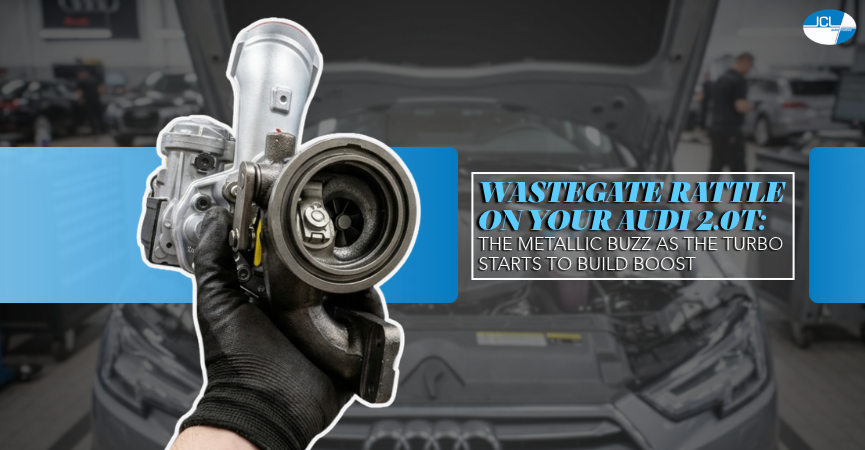
Wastegate Rattle on Your Audi 2.0T: The Metallic Buzz as the Turbo Starts to Build Boost
A wastegate rattle on an Audi 2.0T sounds like loose change in a coffee can, and it comes from the turbocharger, not the engine’s internals. Audi documented it in a 2013 service bulletin for the A3 and TT: the wastegate flap and its rods vibrate as boost control begins, somewhere between 1,800 and 2,900 rpm. Annoying, mostly. But a related clip failure on 2013–2014 2.0Ts disconnects the linkage altogether and can cut power. Around Hellertown, the run into winter and the holiday miles on I-78 make this a good month to find out which one you have.
Quick Summary: Key Takeaways
- The sound: a tinny buzz or rattle from under the car in a narrow rpm band, usually as the turbo starts to build boost.
- The documented cause: Audi’s 2013 bulletin traces the noise on the A3 and TT 2.0 TFSI to wastegate flap and rod vibration from exhaust pulses.
- Audi’s fix: a spring clip fitted to the wastegate adjustment, not a new turbocharger.
- The one to worry about: a lost circlip on the 2013–2014 A4, A5, A6, Q5 and TT 2.0 TFSI disconnects the linkage, lights the check engine lamp and can cost power.
Wastegate Rattle Comes From the Turbo’s Bypass Flap
The wastegate is a small flap on the turbocharger’s exhaust side that opens to let exhaust bypass the turbine, which is how the engine limits boost. A rod connects that flap to an actuator. Any play at that joint lets the flap and rod chatter against each other when exhaust pulses hit them.
That chatter is the rattle. On the transverse 2.0 TFSI, Audi spelled out the conditions in technical service bulletin 2027585/4, dated June 24, 2013, which covers the 2008–2013 A3 and 2008–2014 TT and describes rattling or jarring noises between 1,800 and 2,900 rpm. Exhaust pulses set it off.
Some owners notice it most on cold mornings, with the cabin quiet and the fan low, but the bulletin itself ties the noise to engine speed rather than temperature, so a fully warm engine can rattle just the same.
A Rattle With No Warning Light Is a Different Problem From P0299
Audi has two bulletins on this joint. They describe very different faults. The 2013 rattle bulletin lists no fault code at all, the car drives normally, and it simply sounds cheap.
That second fault is worse. Audi bulletin 2039006/2 from November 2014 covers 2013–2014 A4, A5, A5 Cabriolet, A6, Q5 and TT models with the 2.0 TFSI, where the circlip joining the wastegate actuator rod to the flap lever can fall off. Once that clip is gone, the linkage is disconnected, the check engine light comes on with underboost code P0299, and the driver may notice a drop in power.
So listen and look. Rattle without a light points one way; a light plus soft acceleration points the other, and a multi-module scan settles it.
Audi’s Published Fix Is a Clip, Not a Turbocharger
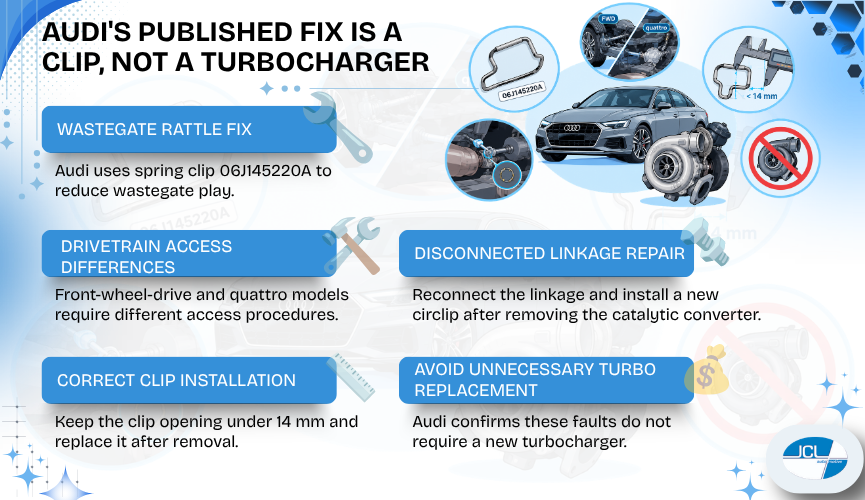
Neither bulletin replaces the turbo. For the rattle, Audi specifies a spring clip, part 06J145220A, fitted over the wastegate adjustment to take up the play. On front-drive cars the underbody noise insulation and driveshaft cover come off for access; on quattro cars the technician reaches in from behind after the propshaft heat shield is removed.
The fitting is fussy: the clip must not be stretched past a 14 mm opening, it has to be replaced every time it is removed, and the original circlip’s position gets checked while the area is open.
For the disconnected linkage, the catalytic converter comes off for access, the linkage is reconnected and a new circlip goes on. Audi’s own note says the turbocharger itself does not need replacing.
So a quote for a new turbo on either fault deserves a hard look.
Not Every 2.0T Buzz Is the Wastegate
Sound carries under a car. A loose exhaust heat shield or a tired clamp can buzz in the same rpm range and fool even a careful ear, which is why the sound alone isn’t proof.
A proper check puts the car on a lift, finds the source with the engine running and confirms whether the wastegate rod moves more than it should. Model matters too. If yours is a 2.0T A4, A5 or Q5, the 2013 rattle bulletin doesn’t list it, so the 2013–2014 clip bulletin (when the year fits) and the exhaust hardware come first.
Routine service is the easy time to ask.
How JCL Automotive Sorts Out an Audi Turbo Rattle
JCL Automotive has worked on Audi, BMW, Mercedes and Tesla since 2005, and its Audi page names VAG-COM/VCDS for scanning, software that reads every control module rather than only the engine. A stored boost fault changes the whole diagnosis.
Next comes the inspection. The rattle gets located on the car, the linkage gets inspected, and you hear the finding before any work is approved, with text and email updates while the car is in the shop. Repairs carry a 24-month/24,000-mile nationwide warranty, which still covers you two states away on a holiday drive.
The shop serves drivers from Bethlehem, Allentown, Easton and Quakertown, and a nationwide warranty plus a full module scan is worth a short trip across the Lehigh Valley.
Frequently Asked Questions
Q: Is wastegate rattle dangerous on an Audi 2.0T?
A: The rattle Audi describes for the A3 and TT is a noise issue with no fault code. A disconnected linkage is different: it sets P0299, lights the check engine lamp and can reduce power, so have the source confirmed rather than guessing.
Q: How does Audi fix a wastegate rattle?
A: On the 2008–2013 A3 and 2008–2014 TT 2.0 TFSI, Audi’s bulletin calls for a spring clip, part 06J145220A, on the wastegate adjustment. It doesn’t replace the turbocharger.
Q: What does a wastegate rattle sound like?
A: A tinny, metallic buzz from under the car, usually in a narrow band between about 1,800 and 2,900 rpm as boost starts to build. Past that range, it usually fades.
Let JCL Hear the Rattle on Main Street
Bring the car in the way you normally drive it, and note the rpm where the buzz shows up, whether it happens cold or warm, and whether the check engine light has come on. A short recording of the noise on your phone helps too. Then pick a time with the Book Appointment button on jclautomotive.com and head to 70 Main St in Hellertown, PA 18055, where a rattle that only shows up around 2,000 rpm can be traced to its source before anything gets replaced.