
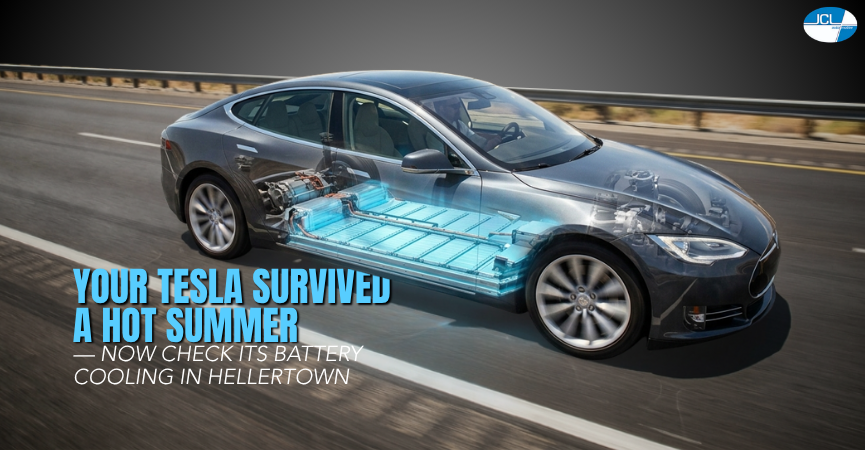
Your Tesla Survived a Hot Summer — Now Check Its Battery Cooling in Hellertown
Ninety-four degrees on Route 412 back in July, traffic crawling, air conditioning at full blast. Your Model 3 spent that whole stretch cooling the cabin and the battery pack off one shared loop, and now, in September, the range estimate still slides lower than the miles you’re covering.
Some of that is normal physics. The rest is wear. A summer’s worth of heat cycles is what finally kills the coolant pump, the low-voltage battery, the AC compressor — and those parts tend to quit after the heat breaks, not during it. We service Tesla alongside BMW, Mercedes and Audi here in Hellertown, and September is our busiest month for thermal complaints from Route 412 commuters.
Quick Summary: Key Takeaways
- Range loss is real and measurable: hot-weather driving with the AC on can cut EV range by roughly 17 percent.
- Precondition while plugged in: cooling the cabin on wall power instead of pack power protects both range and battery temperature.
- The 12V or 16V battery is the usual culprit: heat shortens its life, and its failure looks like a dozen unrelated faults.
- Watch charge habits above 90 degrees: repeated Supercharging on hot days raises pack temps and slows the taper.
- Keep tires at the door-jamb spec: most Model 3 and Model Y trims call for 42 to 45 psi, and low pressure quietly eats range.
Heat is the main thing standing between your pack and its rated range
A Tesla battery wants to live between about 68 and 95 degrees. That takes work. The car circulates coolant through the pack, routes it through a chiller shared with the cabin AC circuit, and leans on the compressor to do double duty on the hottest days. One weak part changes everything downstream.
Model 3 and Model Y use a heat pump and an eight-way valve assembly to move that heat around. Older Model S and X systems are simpler, with a separate resistive heater and a more conventional refrigerant loop, though the same coolant pump does the heavy lifting. It’s the part we replace most once the heat breaks.
Hot weather range loss follows a predictable pattern
Expect to lose range on the hottest days. The Department of Energy reports that electric vehicle range can drop about 17 percent at 95 degrees with the air conditioning running, and gridlock on I-78 makes it worse. The number isn’t a defect.
You can claw much of it back. Park in shade. Precondition on the charger before you leave, and use seat ventilation instead of dropping the cabin to 65 degrees on a 95-degree afternoon. Small changes stack up.
The low-voltage battery is our most common post-summer Tesla failure
Heat kills small batteries first. The 12-volt lead-acid unit in older cars and the 16-volt lithium pack in newer Model 3 and Model Y vehicles both degrade faster in sustained heat. When either gets weak, the symptoms scatter in a way that sends owners chasing the wrong repair entirely. Voltage first.
You’ll see it as random alerts, a door handle that won’t respond, a screen reboot, or a car that won’t wake from sleep. Test it. A load test takes minutes and settles the question, which beats replacing a door module on a hunch.
A weak air conditioning system is a battery cooling problem too
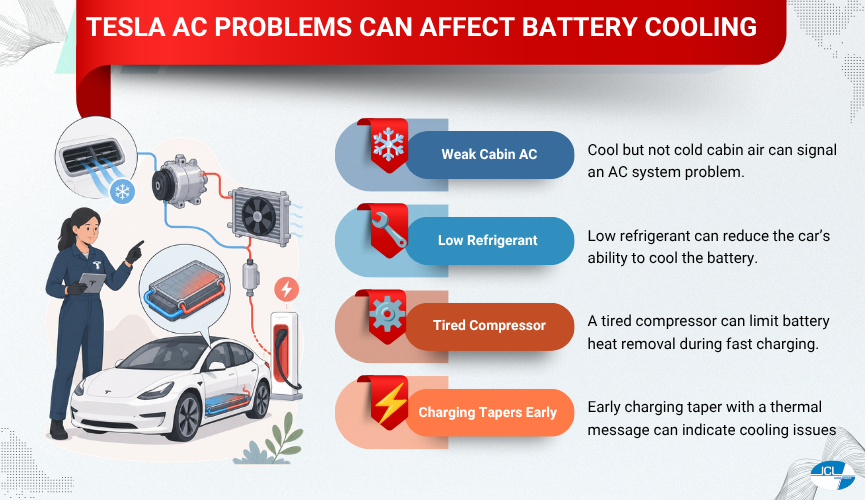
On a Tesla, cabin AC and pack cooling share hardware. That matters more than comfort. A low refrigerant charge or a tired compressor strips the car’s ability to pull heat out of the battery, right when it needs that ability most during a fast charge. Comfort is the symptom.
Signs to bring in: cabin air that’s cool but not cold, a compressor you can hear cycling constantly, or a charging session that tapers early with a thermal message. Leaks are found with dye and gauges, not guesswork.
September charging habits still matter more than April habits
Charge cooler, charge smarter. Daily charging to 80 percent is easier on the pack than sitting at 100 percent in a hot driveway. On a road trip, letting the car precondition the battery on the way to a Supercharger keeps the session short instead of watching the rate crawl.
Two more things worth doing. Leave a little headroom before back-to-back fast charges on a 95-degree day, and check tire pressures monthly, cold, before you drive. Underinflation costs range on every trip. Small habit, real miles.
Hellertown Tesla owners can skip the service center wait
We’re on Main Street, minutes from Route 412 and I-78, and we’ve been servicing European cars here since 2005, with Tesla added as those cars arrived. Tesla work runs alongside our BMW, Mercedes and Audi service, with factory-level scan tools, ASE-certified technicians and a 24-month, 24,000-mile nationwide warranty on the repairs we perform. Often same day.
Drivers come to us from Bethlehem, Allentown, Easton and Quakertown, usually because the appointment is sooner and the updates are clearer. No mystery invoices. You’ll get texts as the diagnosis develops, and a written estimate before we touch anything. Start to finish.
Frequently Asked Questions
Q: Why does my Tesla lose range in hot weather?
A: Because the car spends energy cooling the cabin and the battery pack at once, and the Department of Energy puts hot-weather EV range loss near 17 percent at 95 degrees with the AC on. Preconditioning on the charger and parking in shade recovers a good chunk of it.
Q: How do I know if my Tesla 12V battery is failing?
A: Look for unrelated warnings at the same time: door handles or windows acting up, screen reboots, a car that won’t wake, or a low-voltage alert. Summer heat accelerates the failure. A load test confirms it in minutes.
Q: Can an independent shop service a Tesla in the Lehigh Valley?
A: Yes. We service Tesla at our Hellertown shop, including cooling system work, low-voltage battery replacement, AC repair, brakes, suspension and diagnostics. Warranty-specific and high-voltage pack repairs still route through Tesla.
Q: Is it bad to Supercharge a Tesla on very hot days?
A: Occasional hot-weather fast charging is fine, since the car protects itself by slowing the rate, but doing it repeatedly at high state of charge in extreme heat adds stress over time. Precondition on the way there and stop around 80 percent when you can.
Schedule Tesla cooling and battery service in Hellertown
If range dropped off sharply over the summer or the AC feels weak, get it looked at before the pack starts limiting charging. We’ll test the loop, the compressor and the low-voltage battery. Sooner is cheaper.
JCL Automotive — 70 Main St, Hellertown, PA 18055
Hours: Mon–Fri 8:30 AM–6:00 PM; Sat sales by appointment only; Sun closed
Website: jclautomotive.com