

A Mercedes-Benz transmission is a precision-engineered assembly that keeps fluid sealed under pressure through thousands of heat cycles over the life of the vehicle. When that seal breaks down — and on high-mileage examples it often does — transmission fluid loss begins a slow process that can escalate from a minor service item to a major rebuild if left unaddressed. At JCL Automotive in Hellertown, we service Mercedes transmissions across the 5-speed, 7-speed 7G-Tronic, and 9-speed 9G-Tronic platforms, and we see a consistent pattern: drivers who address leaks early pay a fraction of what drivers pay who wait until the transmission starts slipping or overheating. Get expert transmission service and repair in Hellertown today.
How Transmission Fluid Loss Damages a Mercedes
All models of Mercedes automatic transmissions use ATF (Automatic Transmission Fluid) for lubrication, hydraulic actuation of the clutch packs and shift solenoids, and cooling. The fluid doesn’t just prevent wear — it’s the medium through which the transmission’s internal hydraulic circuits communicate shift commands. When fluid level drops, the hydraulic pressure in these circuits falls below design specification, and the transmission’s behavior changes in ways that compound damage over time.
Early low-fluid symptoms are subtle: slightly slower or less decisive shifts, a momentary hesitation between gear changes at low speed, or a mild shudder during torque converter lockup. These are easy to dismiss as normal behavior for a high-mileage transmission, but they’re the early warning signs of a system under hydraulic stress. Continued operation with progressively lower fluid causes the clutch packs to slip — the friction material wears at an accelerated rate, and the heat generated by slipping clutches further degrades the remaining fluid.
Common Leak Points on Mercedes Transmissions
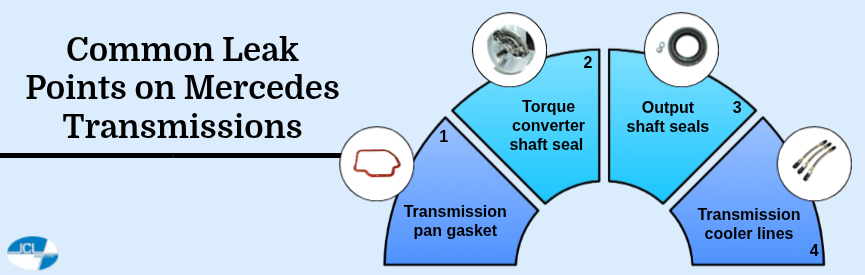
The most frequent source is the transmission pan gasket. The pan bolts to the bottom of the transmission case and seals the fluid sump. On Mercedes 7G-Tronic transmissions, the pan is an integrated module that houses the valve body, solenoids, and the mechatronic unit — which means a leaking pan is particularly important to address because the module it houses is expensive to replace if contaminated. The pan gasket degrades from heat cycling and age, and it’s common to find seeping fluid along the pan rail on Mercedes vehicles with 80,000 or more miles.
The torque converter shaft seal is a rotary seal where the torque converter shaft passes through the transmission bellhousing. When this seal fails, fluid migrates between the torque converter and the transmission housing, eventually reaching the flexplate and lower bellhousing area. Drivers often notice this as a ring of ATF on the bottom of the bellhousing, which can be misdiagnosed as a rear main engine seal leak. Distinguishing between the two requires careful identification of the fluid’s point of origin — ATF has a distinct reddish color and different viscosity than engine oil.
The output shaft seals — front and rear, where the driveshaft connects to the transmission — are subject to wear from the rotational friction of the driveshaft yoke. Output seal failure produces fluid loss that collects at the driveshaft connection points and can drip onto the exhaust or driveshaft tunnel.
Finally, the transmission cooler lines — rubber or metal lines that route fluid to the radiator or external cooler — can develop leaks at their connection fittings or along the line itself from vibration fatigue. These leaks are often mistaken for engine coolant leaks because the cooler is integrated with the radiator on many Mercedes platforms.
Diagnosing Mercedes Transmission Leaks
Accurate diagnosis starts with a trusted Mercedes mechanic skilled in identifying the actual fluid — ATF versus engine oil versus power steering fluid all look similar at a quick glance, but behave differently under UV dye inspection. A leak that appears to be coming from the transmission pan may trace back to an upper case seal when the vehicle is examined on a lift with the underside cleaned and a UV dye added to the fluid.
On Mercedes vehicles with the integrated mechatronic unit, a valve body scan during diagnosis is prudent. We check for solenoid fault codes and adaptation values that may indicate whether the transmission has been operating with reduced fluid long enough to cause electronic adaptation issues that persist even after the leak is repaired.
Contact JCL Automotive in Hellertown
If your Mercedes is leaving spots on your driveway, showing transmission-related warning messages, or shifting differently than it used to, contact JCL Automotive at (484) 851-3390 or visit us at 70 Main St, Hellertown, PA 18055. We’ll identify the leak source precisely and address it before small problems become expensive ones.
Frequently Asked Questions
How do I know if my Mercedes is losing transmission fluid vs engine oil?
Transmission fluid (ATF) is typically reddish and thinner than motor oil. Fresh ATF has a slightly sweet smell; burnt ATF smells acrid. Engine oil is darker and more viscous. Location also helps — fluid directly under the center of the vehicle more often points to the transmission; fluid toward the front or near the oil drain plug points to the engine.
Can I top off my Mercedes transmission fluid myself to buy time?
You can, but we strongly recommend having the leak diagnosed first. Adding fluid without knowing the leak rate risks overfilling if the leak is slow, and Mercedes specifies a particular ATF formulation (typically MB 236.10 or 236.15) that must be matched correctly — using the wrong fluid can damage solenoids and clutch packs.
Does a Mercedes transmission seal replacement require removing the transmission?
Some seals — like the output shaft seals and pan gasket — can be accessed without full transmission removal. The torque converter shaft seal typically requires transmission removal. The scope of labor depends on which seal is failing, which is why proper diagnosis before repair authorization is important.
How often should Mercedes transmission fluid be changed?
Mercedes has historically marketed its 7G-Tronic as a “lifetime fill” transmission, but most independent specialists recommend a fluid change every 40,000–60,000 miles. Fresh fluid significantly reduces thermal stress on seals and clutch friction material and is one of the best preventive measures for transmission longevity.