
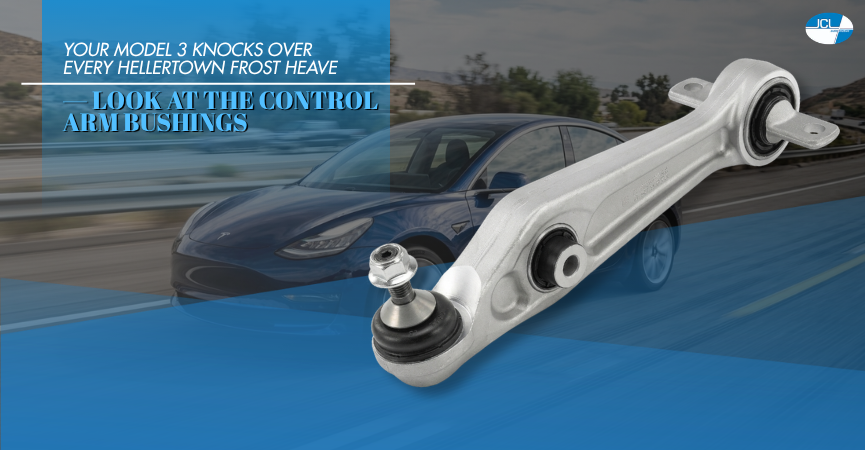
The car is silent. So you hear everything else. That is what makes chasing noise on a Tesla different: there is no engine covering it up. Turn off Main Street onto a broken side street in Hellertown and the front end answers with a dull knock, once per bump, loudest when the pavement is cold.
Usually that is a front control arm bushing. On a Model 3 or Model Y it is a wear item, not a defect — the bushings carry a heavy car over rough Lehigh Valley roads, and October stiffens the rubber enough to start it talking. Catch it now and you replace an arm. Wait and you buy tires too.
Quick Summary: Key Takeaways
- What is knocking: The rubber-and-steel bushings locating the front control arms let the arm shift a few millimetres fore and aft, and that movement lands as a knock.
- Where you hear it: Low speed, broken pavement, one knock per bump — louder over frost heaves, quiet on smooth asphalt.
- Why Teslas wear them: The battery pack puts real weight on the front suspension and instant torque loads the bushings every time you pull away.
- The hidden cost: A loose arm changes toe under load, which scrubs the inside edge of the front tires long before the noise gets bad.
- Our credentials: European specialist since 2005, ASE-certified technicians, 24-month/24,000-mile nationwide warranty on the work.
Control arm bushings are the quiet hinge your suspension pivots on
Each front control arm bolts to the subframe through a bushing: a steel sleeve bonded into rubber and pressed into the arm. The rubber lets the arm swing up and down over bumps while holding it still fore and aft. And that second job is the one that fails.
Once the rubber cracks or separates from the sleeve, the arm gains a few millimetres of travel it should not have. Braking pulls it back, acceleration shoves it forward, and every seam in the road slams it between those two positions. The clunk you hear is a small piece of rubber that has stopped holding a 4,000-pound car in place.
Nothing here is unique to Tesla. Every independent suspension uses these bushings. What differs is the weight the front arms carry and the torque they absorb from a standing start, which is why we find play in the lower arms of a Model 3 or Model Y before anything at the rear gives up.
The noise arrives long before the steering feels wrong
Worn bushings talk before they change how the car drives, which is why the knock is worth acting on early. Note where it happens. Low speed, one wheel at a time, over a lip or a pothole edge rather than smooth road.
Then try the brake test. Roll at 10 mph in an empty lot, brake gently, release, repeat. A loose bushing often produces one knock as the arm shifts back and settles, and if the sound comes on cue you have narrowed it to the front arms.
Eventually you feel it too. Vague steering just off center, a shimmy under braking, the car following ruts instead of ignoring them. By then the inside shoulder of a front tire is often worn smooth while the rest of the tread looks new.
Lehigh Valley pavement is why these wear out early
Pennsylvania roads are hard on suspension rubber, and the numbers say so. ASCE’s 2025 Infrastructure Report Card rates 51% of Pennsylvania’s roads as being in poor or fair condition.
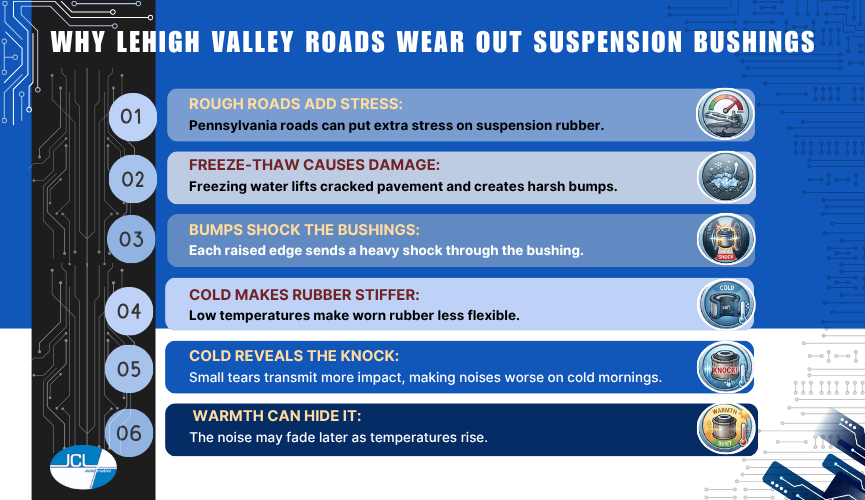
Freeze-thaw does the damage. Water works into a crack, freezes overnight, lifts the slab and drops it, and by late autumn those lifted edges line the older stretches between Hellertown, Bethlehem and Easton. Each one sends a shock load straight through the bushing.
Cold matters by itself. Rubber goes stiff below about 40 degrees, so a bushing with a small tear stops damping the hit and starts transmitting it — which is why the knock shows up on the first cold mornings and fades by afternoon.
Waiting turns a bushing job into a tire job
Toe changes every time the arm shifts, and that scrubs rubber off the inside edge of the front tires, which is how a set of otherwise healthy tires loses several thousand miles of life while the outer tread still looks close to new. But tires cost far more than bushings.
Rough roads already cost the average American driver over $1,400 a year in vehicle operating costs and lost time, per ASCE’s 2025 roads assessment. Driving on worn bushings is how you land at the high end of that.
There is a safety line, too. A bushing that separates completely lets the arm move under hard braking, and the car will dart. If yours has reached the point where you can move the arm by hand, park it.
How we confirm it and what the repair involves
This is a hands-on diagnosis. No scan tool finds it. On the lift with the suspension unloaded, a technician levers each arm at the bushing and watches for movement between the steel sleeve and the rubber around it. Cracked, weeping or offset bushings are obvious once you know what a good one looks like.
Most Tesla front lower arms get replaced as a complete assembly rather than pressed apart, which gives you a fresh ball joint at the same time. Bolts are torqued at ride height. Toe and camber both move when an arm comes out, so the car needs aligning afterward — skipping it is how a new bushing ruins a new tire.
Frequently Asked Questions
Q: What causes a clunking noise in the front of a Tesla Model 3?
A: Worn front control arm bushings are the most common cause, followed by the upper links and, less often, a strut mount. All three knock once per bump at low speed, and only a hands-on inspection separates them. Guessing means buying the wrong part.
Q: How long do Tesla control arm bushings last?
A: Roads decide it, not the odometer. On smooth suburban pavement they can pass 100,000 miles. On the frost-heaved streets around the Lehigh Valley we find play well before that, especially on cars that spend winter parked outside.
Q: Can I drive my Tesla with a knocking control arm bushing?
A: Briefly and gently. It is not an immediate failure, but wear accelerates once the rubber tears, and the front tires pay for the delay. If the car darts under braking, stop driving it and have it inspected.
Q: Do you need an alignment after replacing control arm bushings?
A: The car does need one. Pulling a control arm changes toe and camber, so it has to be aligned afterward or the new parts will wear the tires unevenly. Sort it out before the tires pay for the delay.
Bring the knock in before winter seizes the bolts
A bushing replaced in October is a straightforward afternoon. The same job in February, after salt has worked into every fastener, takes longer. Tell us which corner knocks and over what kind of bump, and we will confirm it on the lift.
Hours: Mon-Fri 8:30 AM to 6:00 PM; service closed Saturday and Sunday
Website: jclautomotive.com